Repair TipsLocal Guides
Understanding Water Softener Resin and When to Replace It
Water softener resin lasts 10 to 15 years in Diamond Bar's hard water. Learn the signs it's spent, what replacement costs in 2026, and how to tell for sure.
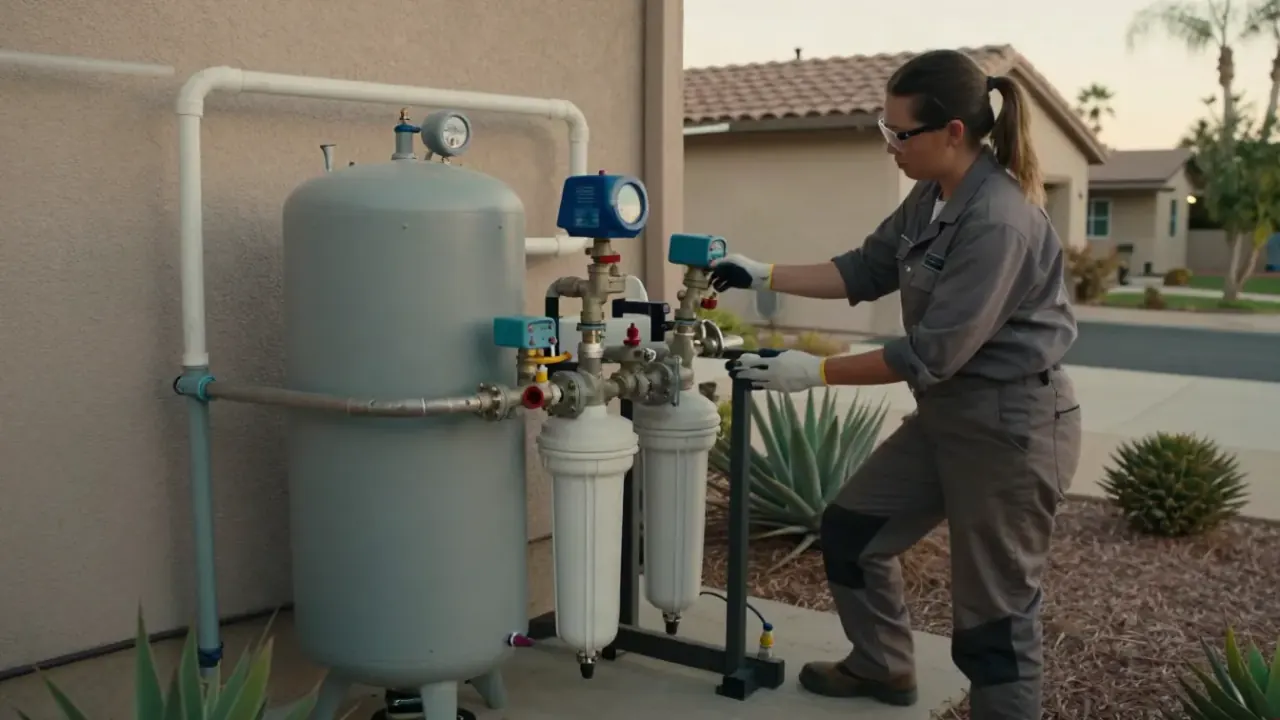
Water softener resin needs replacement when it stops exchanging calcium and magnesium for sodium - usually after 10 to 15 years, or sooner if your water is heavily chlorinated or your softener has been running on a bad setting. If your water suddenly feels hard again, your soap stops lathering, or your softener is using salt without softening anything, the resin is the first thing to test. This guide covers what resin is, how long it lasts in Diamond Bar's water, the exact signs of failure, and what replacement costs in 2026.
What Water Softener Resin Actually Does
Understanding water softener resin and when to replace it starts with one fact: resin is the only part of your softener that actually removes hardness. Everything else - the valve, the brine tank, the control head - exists to keep the resin working.
Resin is a bed of tiny polystyrene beads, each roughly 0.3 to 1.2 millimeters across, charged with sodium ions. As hard water passes through the tank, the beads grab calcium and magnesium and release sodium in their place. That exchange is what makes your water feel slippery and lather properly.
Every few days the softener runs a regeneration cycle, flushing a strong brine solution through the bed to strip the captured minerals and recharge the beads with sodium. A healthy resin bed can repeat that cycle thousands of times. What kills it is not the hardness - it is everything else in the water.
How Long Does Water Softener Resin Last in Diamond Bar, CA?
Water softener resin lifespan in California runs 10 to 15 years for most households, and Diamond Bar sits right in that range. Our water comes from a mix of imported Metropolitan Water District supply and local groundwater, and it lands between 8 and 12 grains per gallon of hardness - solidly hard, but not the worst in Southern California.
What shortens that lifespan here is chlorine. MWD-treated water carries a disinfectant residual that oxidizes resin beads over time. After a decade of exposure, the beads start to fracture, and once they crack, they lose capacity permanently. You cannot recharge your way out of it.
Two other local factors matter. First, homes on private wells in the hills above Diamond Bar often see iron and manganese, which foul resin much faster than plain hardness. Second, softeners sized too small for a household regenerate more often, and every extra cycle is wear on the bed.
If you want a real number rather than a guess, we run a Water Hardness Testing Diamond Bar CA check on the raw supply and on the treated water at the tap. The gap between those two numbers tells you exactly how much capacity your resin still has.
Signs of Bad Water Softener Resin You Should Not Ignore
Signs of bad water softener resin show up in the water before they show up in the tank. Watch for these, roughly in the order they appear:
- Soap stops lathering. You use more shampoo, more dish soap, and the rinse still feels filmy.
- Spotting on glassware and fixtures. White scale returns to shower doors and faucet aerators.
- Salt use climbs while water stays hard. The softener is regenerating, but nothing is sticking to the resin.
- Water feels different. The slick, soft feel you used to notice is gone.
- Resin in the brine tank or on the floor. Brown or amber beads in the salt tank mean the bed is breaking apart.
- Pressure drop at the fixtures. Crushed resin can clog the distributor tube and restrict flow.
That last one is the emergency version. If your whole house loses pressure and you find bead fragments in the brine line, stop running the unit and call us - a broken lower distributor can send resin into your plumbing.
What Causes Resin to Fail Early in California
Resin that dies at year six instead of year twelve almost always has one of four causes. None of them are the resin's fault.
Chlorine and chloramine exposure
Municipal disinfection is the number one resin killer in Southern California. Standard gel resin degrades measurably after roughly 500,000 gallons of chlorinated water. A family of four in Diamond Bar pushes 90,000 to 120,000 gallons a year, so the math catches up faster than most homeowners expect.
Iron and manganese fouling
Iron coats resin beads and blocks the exchange sites. If your water tests above 0.3 ppm iron, you need iron pretreatment ahead of the softener, not just a bigger tank.
Oversized or undersized systems
A softener that is too small regenerates every day instead of every three. That is three to four times the mechanical wear on the bed. We see this constantly in older Diamond Bar homes where a builder-grade unit was installed for a two-person household and now serves five.
Bad regeneration settings
If the brine draw is short, the salt dose is low, or the hardness setting is wrong, the bed never fully recharges. Partially regenerated resin slowly exhausts and then fouls. This is the cheapest failure to fix - and the most common thing we correct on a Water Softener Maintenance Diamond Bar CA visit.
Water Softener Resin Replacement Cost in Diamond Bar, CA
Water softener resin replacement cost in Diamond Bar CA lands between $350 and $900 for most residential systems in 2026, depending on tank size, resin type, and whether the tank itself needs to come out.
Here is how that breaks down. A standard 1-cubic-foot resin tank takes about $150 to $250 in resin and two to three hours of labor. A 2-cubic-foot tank runs $250 to $400 in resin. If the tank is cracked, the distributor is broken, or the unit is a cabinet-style all-in-one, the job becomes a Resin Tank Replacement Diamond Bar CA and the price moves toward the top of the range.
Premium 10% crosslink resin - the type that resists chlorine - costs roughly 30 to 40 percent more than standard 8% resin but lasts several years longer in our water. For most Diamond Bar households, that upgrade pays for itself.
Compare that to $1,800 to $3,500 for a full new softener, and resin replacement is almost always the smarter call when the valve and tank are still sound.
Repair, Replace, or Switch to Salt-Free?
If your valve is under eight years old and the tank is intact, replace the resin and keep the system. If the control head is failing at the same time, price both jobs together - sometimes a new unit is the better number.
Some homeowners use the moment to move away from salt entirely. A Salt-Free Water Conditioners Diamond Bar CA system does not remove hardness the way resin does; it changes how the minerals behave so they do not stick to pipes and fixtures. No salt bags, no brine tank, no discharge line. The trade-off is that the water still tests hard, so if you want that soft feel on your skin, resin is still the answer.
Plenty of Diamond Bar homes run both - a traditional softener for the whole house and a Whole-House Water Filtration Diamond Bar CA stage ahead of it to strip chlorine before it ever touches the resin. That combination is the single best thing you can do for resin lifespan in our water.
Common Mistakes We See With Resin Replacement
Most failed resin jobs we get called to fix were avoidable. These are the patterns.
- Topping off the tank instead of replacing the bed. Mixing new resin with spent resin just dilutes the new material. Pull the old bed out completely.
- Reusing the old distributor tube. If the screen is cracked or the tube is clogged with resin fines, the new bed will fail the same way.
- Skipping the sanitizing step. A tank that sat with fouled resin harbors bacteria. It needs to be sanitized before new resin goes in.
- Not checking the brine system. New resin on a softener with a clogged injector or a bad brine valve will be exhausted within months.
- Ignoring the water chemistry. If you have iron, chlorine, or low pH and you do not fix the cause, you will be back in the same spot in three years.
We see a lot of this in the older tracts around Water Softener in Diamond Point, where original builder softeners from the 1990s are finally hitting end of life and homeowners are deciding between a resin swap and a full replacement.
When to Call a Professional
Call us when you find resin beads outside the tank, when your softener is using salt but the water still tests hard, or when the unit is more than ten years old and has never been serviced. Those three situations almost always mean the bed is done.
We handle resin replacement, tank swaps, valve rebuilds, and full system replacement across Diamond Bar. Our technicians test your raw water and your treated water on the same visit, so you know exactly what you are paying for before we start. If the resin is fine and the problem is a $40 part in the control head, we will tell you that instead.
We also serve the surrounding neighborhoods - from the hillside homes in Water Softener in The High Country to the newer builds near Water Softener in South Pointe - and the water chemistry shifts enough between them that we test on site rather than quoting from a chart.
Frequently Asked Questions
How long does water softener resin last in Diamond Bar, CA?
Ten to fifteen years for most Diamond Bar homes. Chlorinated municipal water pushes it toward the lower end, and well water with iron can cut it to six or eight years. Annual hardness testing tells you where yours actually stands.
How do I know if my water softener resin is bad in California?
Three reliable tests: soap stops lathering, salt consumption rises while water stays hard, and you find amber beads in the brine tank or on the floor. Any one of those means it is time to test the resin bed.
When should I replace water softener resin in Diamond Bar?
Replace it when the treated water tests within 2 grains per gallon of your raw water, when you see resin escaping the tank, or at the 10-year mark if the unit has never been serviced. Do not wait for total failure.
Can I replace the resin myself?
It is possible on a standard two-tank system, but it is messy, heavy, and easy to get wrong. The tank has to be emptied, sanitized, and refilled without disturbing the distributor. Most homeowners have us do it.
Does new resin fix hard water immediately?
Yes, once the system completes a full regeneration and you flush the lines. Expect soft water within one cycle, usually the same day. If it is still hard after two regenerations, something else is wrong.
Get Help With Water Softener in Diamond Bar
If your water has gone hard again or you are seeing resin where it should not be, we can test the bed and give you a straight answer on replacement. Call Diamond Bar Water Softener at (909) 415-2296 and we will get your soft water back.