Repair TipsLocal Guides
Signs Your Water Softener Needs Repair
Spot the seven warning signs your water softener needs repair in Diamond Bar CA - hard water returning, salt bridges, leaks, and valve failures - before they cost you.
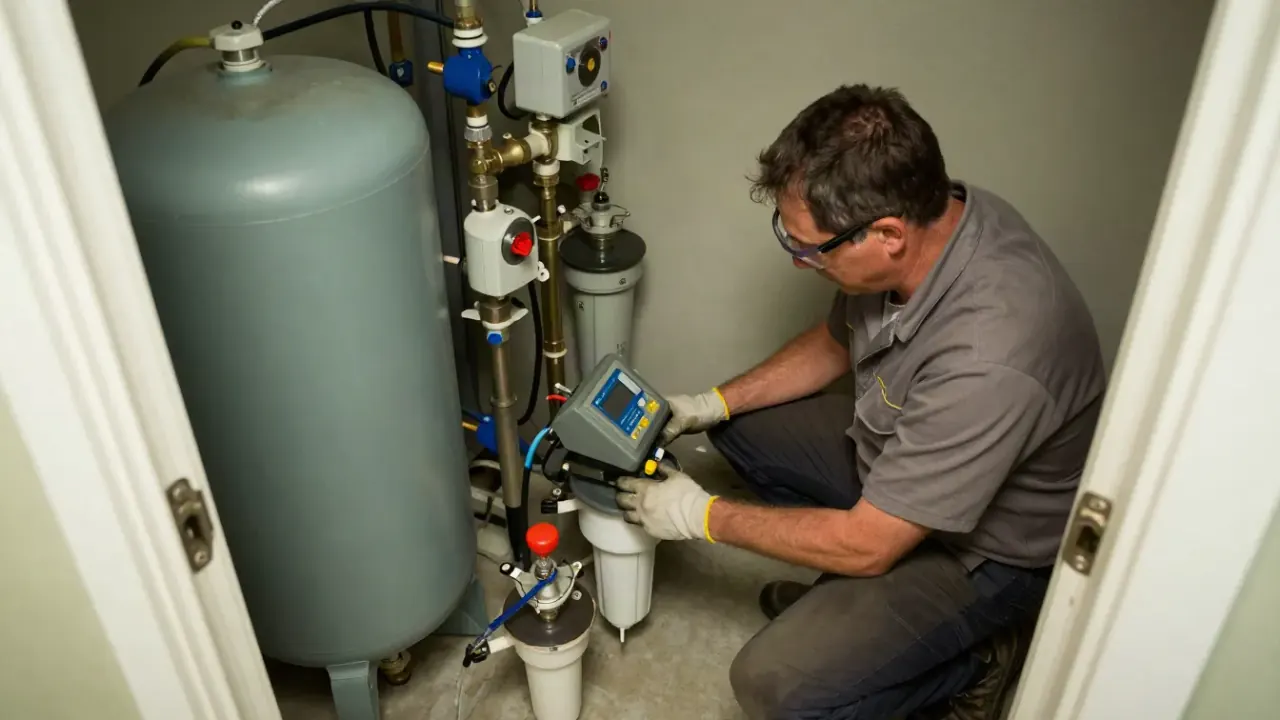
The seven signs your water softener needs repair are: hard water spots returning to your dishes, soap that won't lather, salty-tasting water, a brine tank that stays full of water, unusual noises during regeneration, visible leaks around the unit, and a control head that shows error codes or stops cycling. If you notice two or more of these at once, the softener has stopped doing its job and the resin, valve, or brine system needs attention. We're Diamond Bar Water Softener, and we've walked hundreds of local homeowners through exactly this diagnosis - here's how to tell what's broken, what it costs to fix in 2026, and when a repair beats a replacement.
What Are the First Signs Your Water Softener Needs Repair?
Signs your water softener needs repair are the physical changes in your water, your plumbing, and your softener itself that appear when the ion-exchange process stops working. The earliest and most reliable signal is hard water coming back through the taps - because the resin bed is either exhausted, fouled, or no longer being regenerated properly.
Diamond Bar sits on some of the hardest municipal water in the San Gabriel Valley. Our water arrives from the Metropolitan Water District via the Three Valleys Municipal Water District, and hardness readings across the 91765 and 91789 ZIP codes routinely land between 12 and 18 grains per gallon. That's roughly 205 to 308 mg/L of calcium carbonate. A properly sized softener handles that load easily. A failing one does not, and the change shows up fast.
Watch for these first-stage clues:
- White scale reappearing on faucets, showerheads, and glassware within a week of a cleaning
- Bar soap that leaves a curd instead of a lather
- Laundry that feels stiff or scratchy coming out of the dryer
- Dishes with a cloudy film even after a rinse-aid cycle
- Water heater making more popping sounds than usual
Any one of those alone could be a fluke. Two or more together almost always means the softener has stopped working. If you're not sure whether the problem is the softener or the incoming water, start with Water Hardness Testing Diamond Bar CA - we test the raw supply and the treated supply side by side, so you know exactly where the hardness is getting through.
Why Is My Water Softener Not Softening Water in California?
A water softener stops softening in California for one of five reasons: the resin is exhausted or fouled, the brine tank isn't drawing brine, the control valve isn't cycling, the unit is undersized for the home, or the bypass valve is stuck open. Each one produces a slightly different set of symptoms, and each one has a different repair.
Here's how we narrow it down on a service call:
- Check the bypass first. A bypass valve left half-open after a plumbing repair is the single most common cause of "my softener stopped working" calls we run. It takes two minutes to verify.
- Test the treated water. If hardness is still high at the tap, the resin isn't exchanging ions.
- Inspect the brine tank. No salt, a salt bridge, or a salt mush at the bottom all stop regeneration cold.
- Watch a regeneration cycle. If the control head doesn't advance through backwash, brine draw, rinse, and refill, the valve or timer is the problem.
- Check the resin age. Resin beads last 10 to 15 years in our water. Past that, they fracture and lose capacity.
California also throws a curveball most other states don't: since the state's salinity regulations tightened, some older softeners sold before 2010 use far more water per regeneration than modern units. If your softener is running a 90-gallon regeneration cycle twice a week, it's working harder than it should - and that wear shows up as premature valve failure. We see this constantly in the older tracts around Water Softener in Diamond Point, where a lot of the original 1980s and 1990s builds still have their first-generation softeners in the garage.
Water Softener Not Working Symptoms You Should Never Ignore
Water softener not working symptoms fall into three buckets: water quality symptoms, mechanical symptoms, and electrical symptoms. The water quality ones you'll notice first. The mechanical and electrical ones are the ones that turn a $200 repair into a $1,200 replacement if you let them run.
Water quality symptoms
- Hardness returns within 24 to 48 hours of a regeneration
- Water tastes salty or leaves a salty residue on fixtures
- Iron or rust stains appear in toilets and sinks
- Sulfur or rotten-egg smell in the hot water
Mechanical symptoms
- Water standing in the brine tank above the salt line
- A solid crust of salt (a "salt bridge") with empty space underneath
- Salt disappearing faster than normal - more than one 40-lb bag per month for a family of four
- Visible water around the base of the unit or on the floor of the garage
- Softener running a regeneration cycle at odd hours or back-to-back
Electrical symptoms
- Blank or flickering display on the control head
- Error codes that persist after a power cycle
- Motor runs but the camshaft doesn't turn
- Unit loses its time and settings after every power blip
Any electrical symptom points straight at the control head or its power supply. That's a repair we handle under Softener Valve and Control Head Repair Diamond Bar CA, and it's usually a same-day fix because we carry the common Fleck, Clack, and Autotrol heads on the truck.
Water Softener Making Noise or Leaking? What Each Sound and Puddle Tells You
A water softener making noise during regeneration is normal. A water softener making noise between regenerations is not. The distinction matters because the fix is completely different.
Normal sounds: a soft hum from the motor, the whoosh of water moving through the resin tank, and a low gurgle as brine is drawn down. These happen during the 60 to 90 minutes a regeneration cycle takes, usually at 2 a.m.
Abnormal sounds and what they mean:
- Loud banging or water hammer - usually a pressure issue or a failing inlet valve, not the softener itself
- Grinding or screeching from the control head - worn gears or a failing motor; the head needs service
- Continuous running water sound - the unit is stuck mid-cycle, wasting hundreds of gallons a day
- Clicking that repeats without cycling - the timer or circuit board is failing
Leaks are the other big one. Where the water shows up tells you what's leaking:
- Under the brine tank - usually a cracked tank, a bad float assembly, or an overflowing brine well
- At the control head - O-rings, seals, or a cracked valve body
- At the resin tank base - a failing tank O-ring or a cracked resin tank, which is a replacement, not a repair
- At the bypass or plumbing connections - loose fittings or aged flex connectors
If you're seeing water on the garage floor in a home around Water Softener in Sycamore Canyon, shut the bypass valve and call us before the leak damages drywall or the water heater pad. A slow drip can put 20 to 30 gallons a day into your slab or subfloor.
Common Mistakes Diamond Bar Homeowners Make With Water Softener Problems
The most expensive mistake we see is waiting. A $180 valve rebuild becomes a $1,400 replacement when a slow leak rots the control head and the resin tank base over six months.
Other mistakes we run into weekly:
- Adding salt without checking the brine tank. If there's a salt bridge, you're just stacking salt on top of a hollow crust. Break the bridge with a broom handle before you add another bag.
- Assuming the bypass is closed. After any plumbing work - a repipe, a water heater swap, a pressure regulator replacement - verify the bypass. Half the "dead softener" calls we run end with us closing a bypass valve.
- Using the wrong salt. In our water, solar salt crystals work fine, but pellet salt with binders can contribute to bridging. If you've had two bridges in a year, switch salt types.
- Ignoring the resin age. Resin doesn't last forever. After 12 to 15 years in Diamond Bar's water, the beads are fractured and the capacity is gone. No amount of salt fixes that.
- Running a softener that's too small. A 24,000-grain unit in a 4-bathroom house with a pool auto-fill will be exhausted every two days. It'll look like a repair problem when it's really a sizing problem.
- Skipping the annual service. A yearly tune-up under Water Softener Maintenance Diamond Bar CA costs a fraction of a mid-winter emergency replacement.
One more: don't pour drain cleaner or bleach into the brine tank to "clean it out." It destroys the resin. If the brine tank needs cleaning, that's a specific job with specific chemicals - we handle it under Brine Tank Cleaning Diamond Bar CA and it takes about an hour.
When to Call a Professional for Water Softener Repair in Diamond Bar
Call a professional when you see water on the floor, smell burning near the control head, get a persistent error code, or notice hardness returning within a week of a regeneration. Those four situations are the ones where DIY troubleshooting usually makes things worse.
You can safely handle a few things yourself: checking the bypass valve, breaking a salt bridge, adding salt, and confirming the unit has power. Everything past that - opening the control head, replacing seals, swapping a resin tank, or diagnosing a circuit board - needs a technician who has the parts and the pressure-test equipment on the truck.
Our team carries the common control heads, bypass assemblies, and resin tank O-rings for the brands we see most in Diamond Bar: Fleck, Clack, Autotrol, GE, and Whirlpool. Most repairs are done in a single 60 to 90 minute visit. If the unit is past 15 years old and the resin tank is cracked, we'll tell you straight that replacement makes more sense than repair - and we'll show you the numbers side by side.
If you're not sure whether you're looking at a repair or a replacement, we can run a full diagnostic and give you an upfront price before we touch anything. We serve the whole city, from the homes up around Water Softener in The High Country down through the flats near Diamond Bar Boulevard.
Frequently Asked Questions
What are signs my water softener needs repair in Diamond Bar CA?
The top signs are hard water spots returning within a week, soap that won't lather, salty-tasting water, standing water in the brine tank, unusual noises during regeneration, visible leaks, and control head error codes. Two or more together means the unit needs service. Diamond Bar's 12-18 grain water makes these signs show up fast.
Why is my water softener not working in California?
Most often it's a stuck bypass valve, a salt bridge, exhausted resin, or a failed control valve. California's harder municipal water accelerates resin wear, so units past 12 years old commonly lose capacity. A hardness test on the treated water confirms which one you're dealing with in about 10 minutes.
Should I repair or replace my water softener in Diamond Bar?
Repair if the unit is under 10 years old and the resin tank is intact - typical 2026 repair costs run $180 to $650. Replace if it's past 15 years, the resin tank is cracked, or repairs exceed half the cost of a new unit. A new high-efficiency softener runs $1,200 to $2,800 installed.
How much does water softener repair cost in Diamond Bar in 2026?
Typical 2026 pricing: $180-$320 for a valve or control head repair, $250-$450 for a brine tank or float assembly fix, $400-$650 for resin replacement, and $150-$250 for a diagnostic and tune-up. Emergency after-hours calls add $75-$150. We quote upfront before any work starts.
How long does a water softener last in Diamond Bar?
Expect 10 to 15 years for the resin and 15 to 20 years for the tank and valve with annual service. Diamond Bar's 12-18 grain water is harder than the national average, so units here tend to hit the lower end of those ranges without regular maintenance.
Get Help With Water Softener in Diamond Bar
If two or more of the signs above sound familiar, your softener has stopped earning its keep - and every week it runs in that condition puts more scale into your water heater, your fixtures, and your pipes. We diagnose the problem, quote the repair upfront, and usually have you back on soft water the same day.
Call Diamond Bar Water Softener at (909) 415-2296 to schedule service. We cover every neighborhood in Diamond Bar and the surrounding San Gabriel Valley communities.