Local GuidesWater Treatment
Reverse Osmosis vs Water Softener: Which Do You Need
Softener or RO? They solve two different problems. Here's how Diamond Bar homeowners decide which system to install, and when you actually need both.
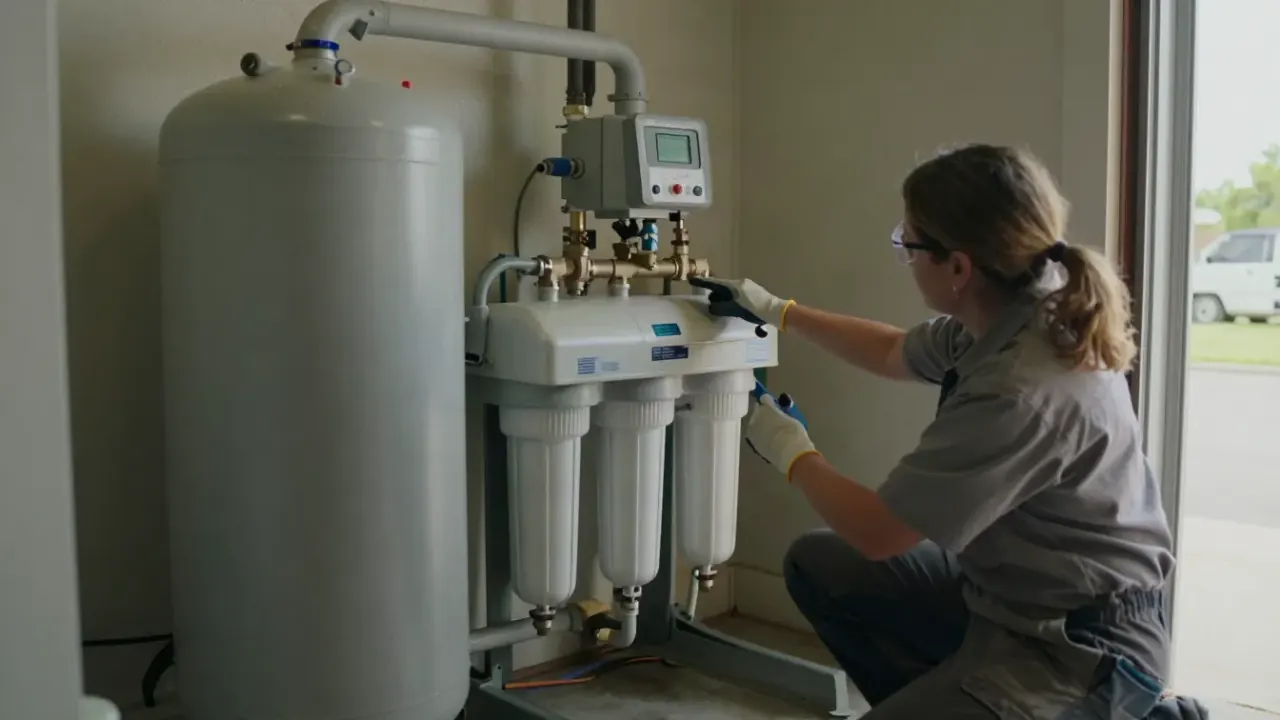
A water softener removes the calcium and magnesium that make Diamond Bar water hard, while a reverse osmosis system removes dissolved solids and contaminants from the water you drink. They are not competitors. They treat two different problems, and most homes here need the softener first.
If your dishes come out spotted and your shower glass fogs up in a week, you have a hardness problem, not a drinking-water problem. If your ice cubes taste flat or your tap water leaves a film in the kettle, that is a filtration problem. Below we break down what each system does, what it costs in 2026, and how to decide whether you need one, the other, or both.
The Short Answer: They Solve Two Different Problems
Reverse osmosis vs water softener is really a question about what you want removed from your water, because the two systems work on completely different scales. A softener targets hardness minerals only. An RO membrane targets almost everything dissolved in the water, including the good minerals.
Diamond Bar sits on some of the hardest water in the San Gabriel Valley. Depending on which import line feeds your street, we measure between 12 and 18 grains per gallon on a standard hardness test. That number matters because anything above 7 grains is considered hard, and above 10.5 grains is officially very hard.
Here is the practical split:
- Water softener: protects pipes, water heaters, dishwashers, washing machines, and fixtures from scale.
- Reverse osmosis: polishes the water at one tap, usually the kitchen sink or the fridge line, for drinking and cooking.
- Both together: soft water through the whole house, plus clean-tasting drinking water at the kitchen.
If you want the whole-house version of that protection, our Water Softener Diamond Bar CA service covers the full install, from the main line tie-in to the first regeneration cycle.
What a Water Softener Actually Does
A water softener is a whole-house appliance that swaps hardness minerals for sodium or potassium ions using a resin bed, then flushes that resin clean on a timed regeneration cycle. Nothing gets removed from the water in the sense of a filter. The calcium and magnesium are exchanged for something softer that will not build scale.
The scale is the whole point. Every gallon of hard water that moves through your copper pipes, your tankless water heater, or your dishwasher leaves a thin mineral deposit behind. At 15 grains per gallon, a family of four pushes roughly 1,800 grains of hardness through the plumbing every single day.
What that looks like in a Diamond Bar house after a few years:
- Water heater efficiency drops as scale insulates the heating element or the tank bottom.
- Showerheads and aerators clog and lose pressure.
- Dishwasher glassware comes out cloudy even with rinse aid.
- Soap and detergent stop lathering properly, so you use more of both.
- Toilets and faucets grow a chalky ring that no cleaner fully removes.
A properly sized softener for a Diamond Bar home usually runs $1,800 to $3,500 installed in 2026, depending on grain capacity, whether you want a twin-tank setup, and how far the main line has to be run. Salt runs the average family about $8 to $12 a month.
If your existing unit is limping, or the resin is more than 10 to 12 years old, Water Softener Repair Diamond Bar CA is almost always cheaper than a full replacement. We test the resin, the valve, and the brine draw before we quote anything.
What a Reverse Osmosis System Actually Does
A reverse osmosis system is a point-of-use filter that pushes water through a semi-permeable membrane, stripping out dissolved solids, heavy metals, chlorine byproducts, and most contaminants down to about 0.0001 microns. It is the closest thing to bottled-water quality you can get at a kitchen tap.
RO does not soften water. It removes the hardness minerals along with everything else, but only at the one tap it feeds. Your shower, your laundry, and your water heater never see it.
A standard under-sink RO in Diamond Bar costs $450 to $1,200 installed. Whole-house RO, which is a different animal entirely, runs $4,000 to $12,000 and needs a storage tank and a repressurization pump because the membrane cannot keep up with shower-level flow.
What you notice with RO running:
- Coffee and tea taste cleaner, with no chlorine edge.
- Ice cubes come out clear instead of cloudy.
- No film on the inside of the kettle.
- You stop buying bottled water, which for a family of four saves roughly $400 to $700 a year.
Filters need attention. Sediment and carbon pre-filters get swapped every 6 to 12 months, and the RO membrane every 2 to 3 years. Skip that and the system quietly stops working the way it should.
The Real Difference Between RO and a Water Softener
The reverse osmosis and water softener difference comes down to scale, scope, and what each one is designed to protect. A softener protects your plumbing and appliances. An RO protects your glass of water.
Put them side by side:
- Coverage: softener treats every gallon entering the house; RO treats one tap.
- What it removes: softener exchanges hardness minerals; RO removes dissolved solids and contaminants.
- Waste water: a modern softener uses about 25 to 50 gallons per regeneration; a standard RO sends 2 to 4 gallons to drain for every gallon it produces.
- Maintenance: softener needs salt and an annual check; RO needs filter changes and a membrane every few years.
- Cost: softener is the bigger upfront ticket; RO is cheaper to buy but only fixes one faucet.
One thing people get wrong: an RO system alone will not stop scale in your water heater. It cannot. The water going to your shower never touches the membrane.
For homes in the older tracts, we see this constantly. A homeowner in Water Softener in Diamond Point replaced a failed softener with a kitchen RO and could not figure out why the dishwasher still etched glass six months later. The RO was doing its job. It just was not the job they needed done.
Which Is Better, RO or a Water Softener, for Diamond Bar Homes?
For Diamond Bar, the water softener is the better first purchase because our municipal supply is hard enough to damage plumbing, and RO does nothing about that. RO is the better second purchase once the hardness is handled.
If you can only do one right now, do the softener. Here is why the order matters:
- Hard water damages the whole house every day. RO protects one tap.
- An RO membrane lasts longer when it is fed softened water, because there is less scale loading on the pre-filters.
- Water heater life in hard water runs 4 to 6 years shorter than in soft water. That is a $1,200 to $2,500 replacement you can push out.
- Softened water makes every soap and detergent in the house work better, which is a monthly saving, not a one-time one.
If your water is hard but you have no taste complaints, the softener alone is the right call. If your water is already soft but you want better drinking water, skip the softener and go straight to RO.
For a full-house approach that handles both, our Whole-House Water Filtration Diamond Bar CA setup pairs a softener on the main line with carbon filtration and a kitchen RO at the sink.
Do I Need Both RO and a Water Softener in California?
You need both if your water is hard and you drink from the tap, which describes most of Diamond Bar. You need only the softener if you are happy with how your water tastes, and only the RO if your water tests soft.
California adds one wrinkle. State plumbing code restricts where softener discharge can go, and some areas have tighter rules on brine lines than others. We handle that on every install, so the drain line runs where it is supposed to.
There is also a salt-free option worth knowing about. If you are on a low-sodium diet or you just do not want to haul salt bags, a Salt-Free Water Conditioners Diamond Bar CA unit changes how minerals behave so they do not stick to pipes, without adding sodium. It will not give you the slippery-soft feel of an ion-exchange softener, but it stops scale.
Before any of this, get a number. Our Water Hardness Testing Diamond Bar CA visit takes about 20 minutes and tells you exactly what you are dealing with, plus what is in the water beyond hardness.
What to Watch Out For
The most common mistake we see is buying a softener that is undersized for the household, then blaming the equipment when the water still feels hard. Grain capacity has to match both the hardness number and the number of people using water.
Other traps:
- Big-box softeners rated for 3 people installed in a five-person home. The unit never catches up between regenerations.
- RO systems with no pre-filter changes. Once the carbon is exhausted, chlorine eats the membrane and the whole unit is done.
- Running an RO on hard water without a softener upstream. You will replace membranes twice as often.
- Ignoring the brine tank. Salt bridges and sludge build up quietly and stop regeneration without any warning light.
- Assuming all hard water is the same. Two streets over, the blend from the water district can shift the number by 2 to 3 grains.
If your brine tank has not been opened in a year, that is worth a look. We handle Brine Tank Cleaning Diamond Bar CA as a standalone service, and it is usually the cheapest fix on this list.
When to Call a Professional
Call us when the softener stops regenerating, when the water pressure drops after the unit, when the salt level will not go down, or when you are ready to install and want the sizing done right the first time. Those are the four calls we get most.
We also get called after a DIY install that leaks at the main line, or after a homeowner buys a unit online and cannot get the bypass valve to seal. Both are fixable, and neither is worth a flooded garage.
Diamond Bar Water Softener works across the city and the surrounding hills. We test your water, size the system to the actual number, install it, and walk you through the salt and filter schedule before we leave. If you are weighing RO against a softener and want a straight answer for your address, we will give you one.
Frequently Asked Questions
Which is better, reverse osmosis or a water softener, in Diamond Bar CA?
The softener is better as a first purchase because Diamond Bar water runs 12 to 18 grains per gallon, and RO does not remove hardness from your plumbing. Add RO afterward for drinking water at the kitchen tap. If your water tests soft, RO alone is enough.
Do I need both RO and a water softener in California?
Most Diamond Bar households benefit from both: a softener on the main line for whole-house protection and an RO at the kitchen sink for drinking and cooking. If budget only allows one, start with the softener, since hard water damages water heaters, pipes, and appliances every day.
What is the difference between RO and a water softener in Diamond Bar?
A softener exchanges calcium and magnesium for sodium across the whole house, stopping scale. An RO membrane forces water through a fine filter at one tap, removing dissolved solids and contaminants. One protects your plumbing; the other polishes your drinking water.
Can I install a reverse osmosis system without a water softener?
Yes, but the membrane and pre-filters will need replacing roughly twice as often because hard water loads them faster. If your hardness is above 10 grains per gallon, running RO on untreated water costs more over five years than adding a softener first.
How much does a water softener cost in Diamond Bar in 2026?
Expect $1,800 to $3,500 installed for a properly sized whole-house unit, plus $8 to $12 a month in salt. Under-sink RO adds $450 to $1,200. Pricing depends on grain capacity, tank configuration, and how far the main line run has to go.
Get Help With Water Softener in Diamond Bar
Tell us your address and what your water is doing, and we will tell you whether you need a softener, an RO, or both. No guesswork, no upsell on equipment you do not need.
Call Diamond Bar Water Softener at (909) 415-2296 to schedule a hardness test and get a straight recommendation for your home.